

Regardless of your industry, traffic is down, and zero-click searches are up.
According to the latest research, almost 60% of generic searches end in zero clicks, while more than 69% of news searches result in no clicks (Similarweb).
Organic click-through rates (CTRs) have also plummeted by 37% - 40% because of Google’s AI Overviews (Malte Landwehr), which now dominate the search results page.
All these factors contribute to a bitter truth that SEOs must swallow: high organic keyword rankings no longer guarantee strong online visibility.
Instead, it’s necessary for all brands to pivot into optimizing for AI search tools.
However, we’re not saying that you should outright abandon organic SEO.
There are niches where classic SEO still yields excellent results, like for local businesses and e-commerce stores.
Google’s Local Pack still dominates local searches, and AI Overviews (AIOs) only appear about 10% of the time for commercial and transactional keywords (WordStream).
For the vast majority of brands, though, improving visibility on AI platforms is the #1 way to maintain online visibility while generating leads and sales.
Yet, in order to track your success, you need to learn new AI SEO metrics. Traditional SEO metrics like CTRs and keyword rankings will no longer cut it.
In this guide, we’ll introduce you to the world of AI SEO reporting so that you can track your visibility on Google’s AI Overviews and platforms like ChatGPT.
Why Traditional SEO Metrics Fall Short

Standard SEO reporting revolves around keyword rankings, domain authority (DA) scores, and backlink quantity.
While this system worked for many years, the problem is that these metrics aren’t set up for AI models.
Large language models (LLMs) and search algorithms weigh authority completely differently, so they each require a distinct set of reporting metrics to properly measure your performance.
The tunnel vision effect

Also, sticking to classic SEO metrics will cause you to form tunnel vision.
Here’s what we mean.
Imagine that you’re ranking #1 for your most important keywords, you have loads of high-DA backlinks, and your DA score is in the 90s. Your content is truly helpful, and you have a strong reputation online.
Yet, your click-through rate keeps falling month after month as your organic traffic takes a nosedive.
From this perspective, it would seem as if SEO no longer works. This could cause you to abandon all hope and cease all search marketing practices.
However, despite poor SEO metrics, you notice that your brand is still generating leads and sales, and that your branded searches and direct site visits have gone up.
How is this possible?
It’s because your strong content and reputation provided online visibility through AI citations on Google’s AI Overviews and AI search assistants.
Why AI SEO metrics matter
In the example mentioned above, your audience didn’t click on one of the ‘blue links’ on Google to find you; they saw your name in an AI citation.
While they may not have taken action immediately, your name stuck in their head, and they decided to look you up later.
Without AI SEO metrics in place, you’d have no idea this was taking place.
That’s the #1 reason why traditional SEO metrics no longer capture the full picture. Even if you’re still focusing on organic SEO (like for a local business), you should add AI SEO reporting into the mix to catch any leads you may generate through AI tools.
Also, you should start optimizing for AI search even if your business is still benefiting from organic SEO. It’s only a matter of time until AI-powered tools start dominating local searches and online shopping, so you’d best be the early worm in this scenario.
What AI Visibility Looks Like: KPIs You Should Track

To understand how to monitor your AI visibility, you need to know how LLMs establish trust with brands.
An AI model won’t just cite or recommend anyone. Instead, they ensure each brand they cite is credible by:
- Analyzing its branded web mentions online for editorial quality and context.
- Checking its reviews across multiple platforms like Google, Yelp, and Amazon.
- Weighing brand sentiment through community chatter (forums like Reddit and social media platforms)
- Ensuring content quality and topical authority.
- Benchmarking brands by comparing them to competitors.
- Checking user behavior metrics like direct brand searches and branded anchors.
That’s the cliff notes version of how LLMs weigh online authority and trust.
Bearing this in mind, we can build specific optimization tactics based on these factors, like building brand mentions and generating positive reviews.
However, in terms of tracking AI visibility, here are the KPIs you should pay the most attention to.
Brand mentions and backlinks (editorial quality and context)
Positive, contextually relevant brand mentions and backlinks are what move the needle in AI search.
They’re what builds trust with LLMs, and they reinforce entity association, meaning AI models will learn to closely associate your brand with your niche.
However, contextual relevance and editorial quality are paramount here.
Don’t worry about the Domain Authority scores of the websites you target for backlinks and brand mentions. DA scores are based on Google’s search algorithm, not modern LLMs, so it no longer applies.
Instead, try to build mentions and links on sites that:
- Are trusted voices in your industry
- Related websites frequently cite and link to
- Also frequently appear in AI-generated responses (which is a surefire sign that LLMs trust them)
Context also matters more than it did with organic search. This means your backlinks have to make sense and provide actual value to the linking website’s audience. Irrelevant or negative brand mentions won’t count towards your authority.
Citation frequency
How often is your brand getting cited by tools like ChatGPT, Perplexity, and Claude?
This is the central question behind citation frequency, a crucial KPI in AI SEO. Obviously, you want your brand to get cited and recommended as often as humanly possible, but you can’t improve your citation frequency if you don’t know what it is.
The good news is that there are plenty of ways to find out, including manual methods that are completely free.
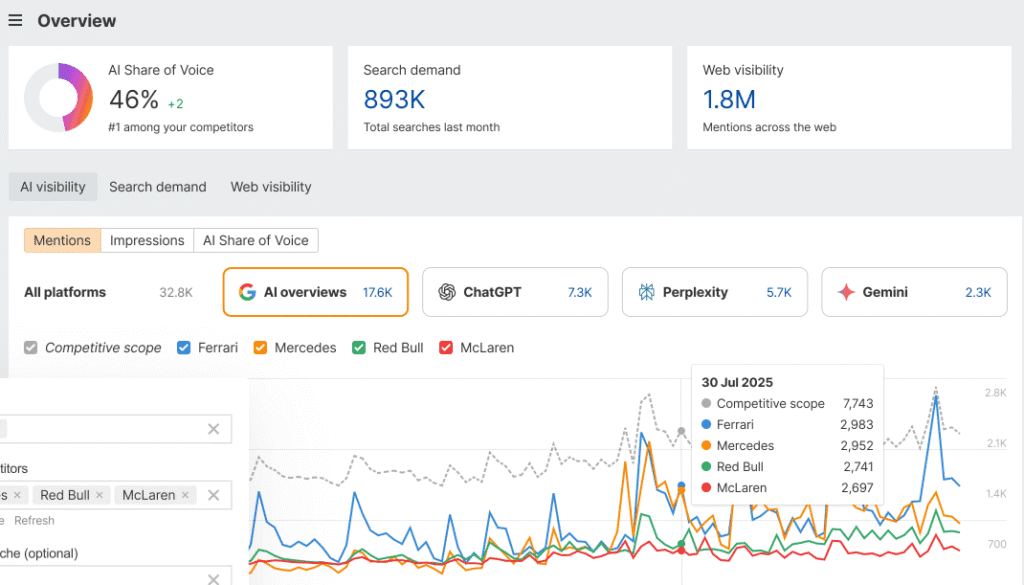
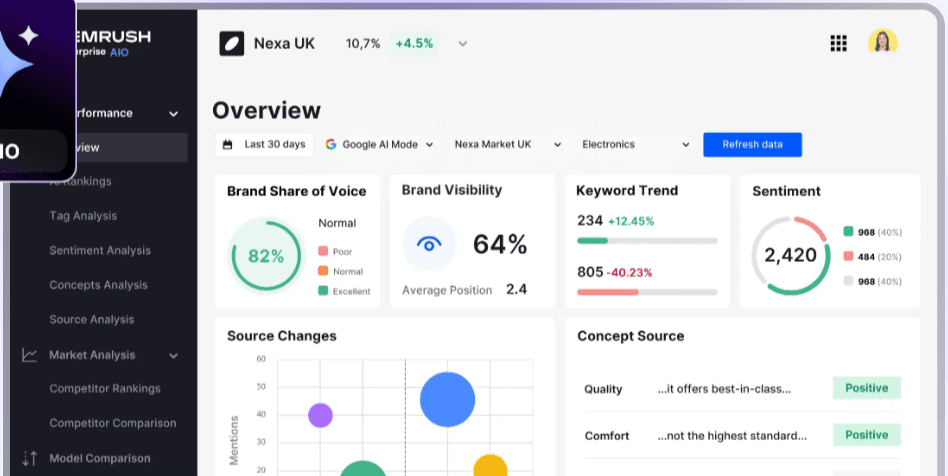
Probably the quickest and easiest way to find out is to use a paid tool like Ahrefs, Semrush, or BrightEdge’s AI Catalyst.
Ahrefs has its Brand Radar, which provides a visibility overview for all the major AI platforms, including your share of voice compared to your competitors:
Semrush provides similar features with its AI Visibility Index:
You can also conduct prompt research (the AI SEO equivalent of keyword research) using Ahrefs and Semrush.
Both platforms are great choices if you already subscribe to them to track your organic SEO campaigns.
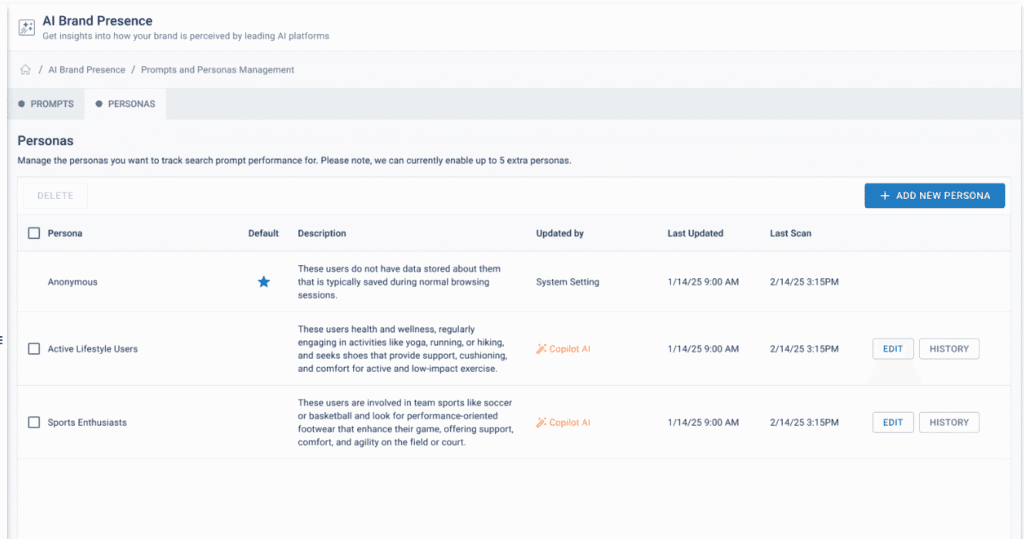
BrightEdge’s AI Catalyst is another solid option, and it even grants you the ability to reveal your audience’s typical AI-driven buyer’s journey:
AI Overview inclusion
It’s crucial to know how visible you are in Google’s AI Overviews since they now dominate its search results page.
If you generated lots of leads through informative content before AIOs became a thing, then you’ve probably seen your organic traffic for those pages plummet.
That’s because Google’s AIOs kicked off the zero-click era that we’re currently living through.
However, if your content was already ranking well before AIOs and genuinely provides helpful insights, the chances are high that you’re already appearing in AIOs.
Luckily, many tools can now track which keywords generate AIOs for you, including the aforementioned Ahrefs and Semrush. Keyword.com also has an AI Overview tracker tool, and SEO.com’s AIO checker lets you perform 3 free searches per day.
How to Track AI Visibility Without Relying on Tools
Next, let’s learn how you can build out a comprehensive reporting system for tracking your AI visibility.
We’ve mentioned some helpful tools already, but these methods will help you establish a strong foundation that you can embellish on later with paid tools.
Custom AI visibility dashboards
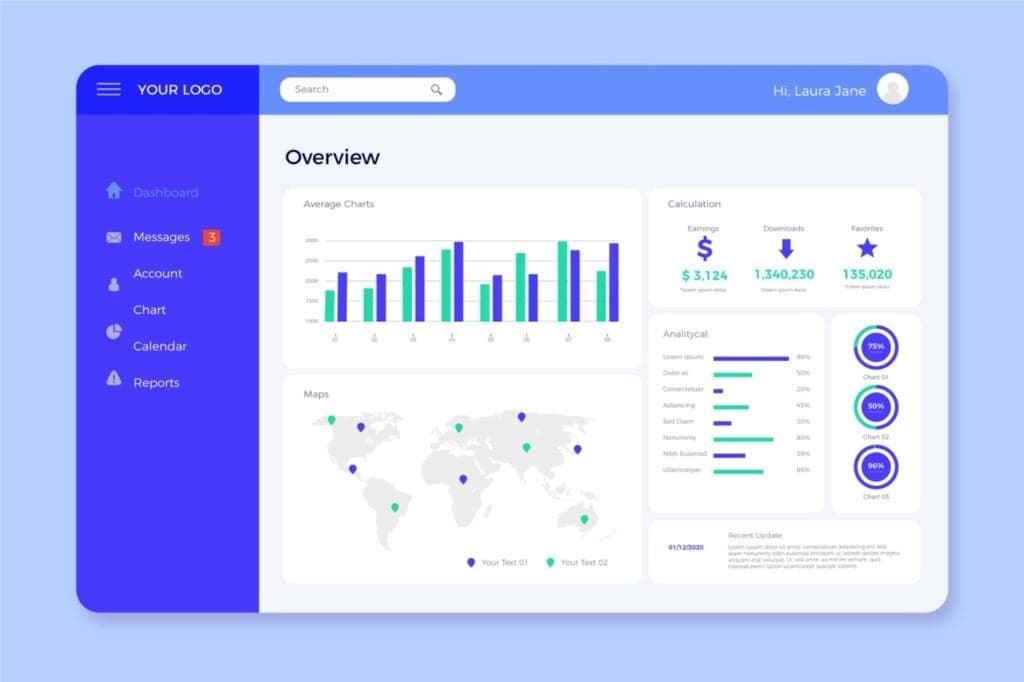
While some AI tracking tools are available now, most of the reporting is still fragmented across multiple platforms.
With custom dashboards, you can merge your most important AI SEO KPIs into a single location.
The first step is to compile the necessary raw data via APIs:
- Ping the APIs for AI search platforms like Perplexity and Bing Copilot to see how often your brand gets cited.
- For platforms that don’t have APIs, like ChatGPT, you can use a SERP simulator like ZipTie, SEOTesting, or RankRanger. These will simulate AI search queries and log the brands that get cited in the results.
- Next, you need to add brand sentiment into the mix by including social listening and review APIs. Common choices include Reddit API, Google Reviews API, and Yelp Fusion API.
Once you’ve got the raw data, it needs to be processed using Python scripts or ETL (extract, transform, load) tools like Airbyte or Fivetran.
After that, you need to add natural language processing (NLP) using a tool like OpenAI API or Google Cloud NLP. This step ensures that the data becomes ‘semantic.’
The final step is to use a visualization tool like LookerStudio or PowerBI to put everything together in a centralized dashboard.
It’s a lot of work to set one of these up, but they’re invaluable for guiding your strategy since they’re fully customized for your brand’s data and AI search performance.
Custom dashboards negate the ‘one-size-fits-all’ limitations of generic subscription tools, so they’re great if you like doing things your own way and want to gain more actionable insights.
HOTH’s Reporting Advantage with AI Discover
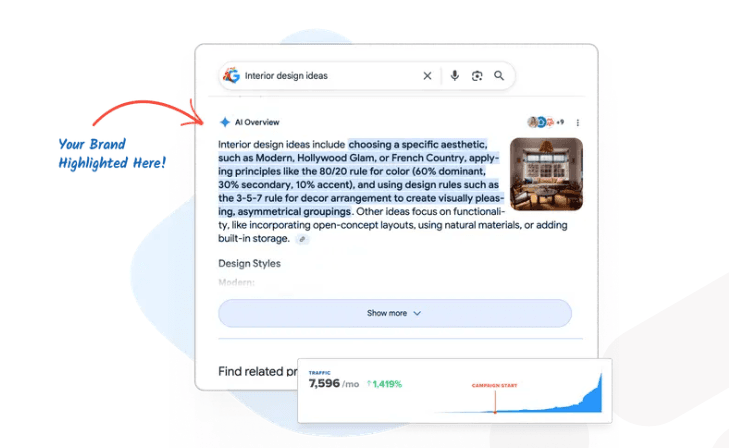
We saw the impact AI was going to have on search coming from a mile away, so we were already prepared when it took over.
In fact, we recently launched a new product, AI Discover, that specifically improves brand visibility on generative AI platforms.
We noticed that our SEO best practices (focusing on content quality, top-tier backlinks, and positive brand sentiment) were already translating into strong AI visibility for our clients.
To make it even better, we adopted the Search Atlas LLM Visibility dashboard, which is the most elaborate AI dashboard available.
If you want to ensure your brand gets cited by AI platforms like ChatGPT, don’t wait to try out AI Discover today.
Final Thoughts: AI Visibility Reporting
In short, marketers have to pivot their organic SEO strategies to include AI SEO, or transition entirely.
To do so, a new set of KPIs and metrics is necessary, as we’ve discussed in this article.
Instead of obsessing over keyword rankings and DA scores, it’s now about brand mentions and citation frequency.
Do you feel overwhelmed by the massive changes the search landscape has gone through recently?
Book a free strategy call with our team of experts to put your mind at ease and discover the best path forward for your brand!
The author
Rachel Hernandez
description

Previous
Responding to Bad Google Reviews: How to Safeguard Your Reputation
Next
Reputation as a Ranking Factor: AI Search vs. Classic SEO
Discussion
Comments
ANAMIKA BISWAS
November 8th, 2025
Insightful read! As AI reshapes search visibility, tracking branded reach and engagement is more important than ever. At Cloud Accounting & Tax Services Inc. | CLaTAX, we’re also adapting our SEO and analytics approach to match this AI-driven shift.
Koka Realty
November 6th, 2025
Thanks for this article. This article has good info.
Louise Savoie
November 5th, 2025
This was such an eye-opening read! It’s true that traditional SEO metrics aren’t enough anymore with how AI search tools are changing visibility. The idea of custom AI visibility dashboards also sounds like a smart move for staying ahead. Great insights for anyone adapting to the new AI-driven search era!


