

Pitching SEO to leadership without numbers is like asking for a road trip budget without knowing the destination. You might get a yes, but you're more likely to get skepticism.
SEO forecasting gives you those numbers. It transforms organic search from a vague long-term play into a projection with estimated traffic, leads, and revenue attached. In this guide, I'll walk through the methods, tools, and formulas you can use to build forecasts that actually hold up in a boardroom. I’ll even share insights about common roadblocks and issues with SEO forecasting that our team here at the HOTH sees when planning campaigns.
What is SEO Forecasting
SEO forecasting is the process of predicting future organic traffic, conversions, and revenue by analyzing historical data, search volume, keyword rankings, and conversion rates. Rather than guessing what SEO might deliver using blind estimations, we use forecasting with actual numbers to create a roadmap for growth. The result is a projection you can use to plan content, allocate budget, and set realistic expectations with stakeholders.
At its core, a forecast answers one question: if we invest in SEO, what can we reasonably expect to get back?
- Traffic projections: Estimated visitors based on keyword rankings and search volume
- Conversion forecasts: Predicted leads or sales from that traffic
- Revenue estimates: Projected income tied to your SEO investment
Why SEO Forecasting Matters for Business Growth
SEO results can be difficult to quantify for stakeholders unfamiliar with organic search metrics. You know it works, but proving its value before results show up can be tricky. Forecasting gives you a way to translate optimization work into projected business outcomes before you spend a dollar.
Justifying SEO Budget to Executives
Leadership teams want numbers before they approve budgets. A forecast shows projected revenue against proposed investment, which shifts the conversation from "trust me" to "here's the math." When you can present ROI projections, you're speaking the language executives already use for every other business decision.
Setting Realistic Traffic Growth Expectations
Overpromising is one of the fastest ways to lose credibility. Forecasting helps you establish achievable timelines based on actual data rather than optimism. When expectations are set properly from the start, you build trust even before results arrive.
Comparing SEO Performance to Other Channels
Marketing budgets compete for limited resources. Traffic projections let you compare SEO's potential value directly against paid mediaMarketing budgets compete for limited resources. Traffic projections let you compare SEO's potential value directly against paid media, email, or social. A side-by-side comparison helps you allocate resources where they'll have the greatest impact.
Aligning SEO Strategy with Revenue Goals
Forecasting connects keyword targeting and content decisions to business objectives. Instead of chasing rankings for their own sake, you can prioritize opportunities that actually move revenue.
First-Party vs Third-Party Data for Organic Search Forecasting
Before jumping into forecasting methods, it helps to know where your data comes from. The source affects both accuracy and what you can actually predict.
Google Search Console and Analytics Data
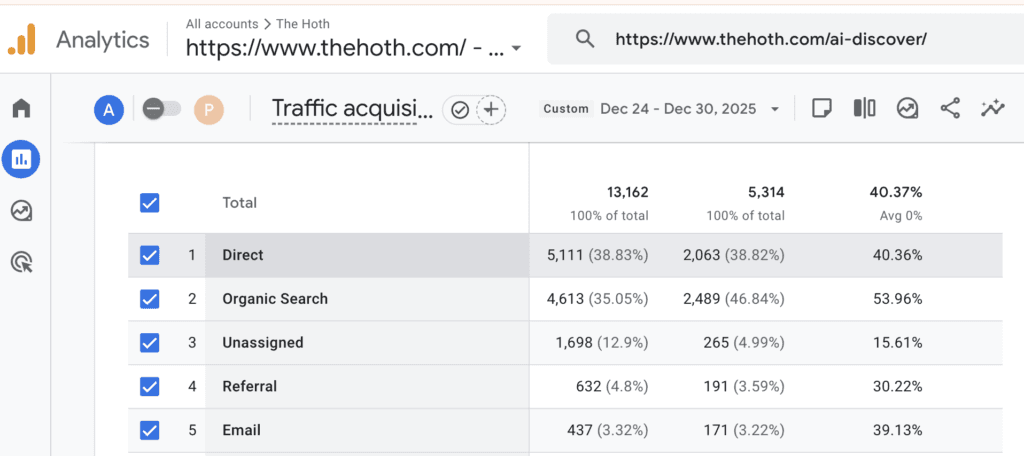
First-party data comes directly from your own website. Google Search Console shows actual clicks, impressions, and average positions for keywords you already rank for. This data is highly accurate for existing performance. However, it has one significant limitation: it tells you nothing about keywords you don't currently target.
Third-Party SEO Tool Data
Tools like Semrush and Ahrefs provide estimates based on their own crawling and clickstream data. They excel at competitor analysisTools like Semrush and Ahrefs provide estimates based on their own crawling and clickstream data. They excel at competitor analysis and identifying new keyword opportunities. The tradeoff is that their traffic estimates may differ from your actual results since they're working with approximations.
Choosing the Right Data Source for Your Forecast
The most reliable forecasts combine both sources. Use first-party data for keywords where you have historical performance, then layer in third-party estimates for new opportunities.
| Data Source | Best For | Limitations |
| First-party (GSC) | Existing keyword performance | Cannot forecast new keywords |
| Third-party tools | Competitor analysis, new opportunities | Estimates may vary from actual |
Keyword-Based SEO Forecasting Methods
Keyword-based forecasting is the most common approach. It follows a logical sequence from search volume to projected revenue, and each step builds on the one before it.
Step 1: Pull Target Keywords and Search Volume Data
Start by gathering your target keyword list along with monthly search volumesStart by gathering your target keyword list along with monthly search volumes from your preferred SEO tool. Focus on keywords that align with your business goals rather than just high-volume terms. A keyword with 500 monthly searches that converts well is often more valuable than one with 10,000 searches that doesn't.
Step 2: Estimate Click-Through Rates by SERP Position
Click-through rate, or CTR Click-through rate, or CTR, represents the percentage of searchers who click on a result at each ranking position. Position one typically captures a much larger share of clicks than position ten. You can use industry benchmarks for this step, though your own historical CTR data from Search Console will be more accurate.
Step 3: Calculate Projected Traffic per Keyword
Here's where the math comes in. Multiply each keyword's search volume by the estimated CTR for your target position.
For example, a keyword with 1,000 monthly searches where you're targeting position three might look like this: 1,000 searches × 10% CTR = 100 monthly visits.
Step 4: Aggregate Traffic Across Your Keyword Portfolio
Sum the individual keyword projections to get your total estimated traffic. This aggregate view shows the combined potential of your SEO strategy across all target terms.
Step 5: Apply Conversion Rates to Forecast Leads and Revenue
Traffic metrics must be connected to conversion and revenue data to demonstrate business value. Apply your website's average conversion rateTraffic metrics must be connected to conversion and revenue data to demonstrate business value. Apply your website's average conversion rate to estimate leads, then multiply by your average order value to project revenue. This final step transforms abstract traffic numbers into business outcomes.
How to Forecast SEO Using Historical Traffic Data
While keyword-based forecasting works well for specific opportunities, historical trend analysis takes a broader view of your site's overall trajectory.
Step 1: Export Historical Data from Google Search Console
Pull at least 12 to 16 months of clicks and impressions dataPull at least 12 to 16 months of clicks and impressions data. This timeframe captures seasonal patterns and provides enough data points for meaningful trend analysis.
Step 2: Identify Traffic Trends and Seasonal Patterns
Look for recurring patterns in your data. Many businesses see predictable fluctuations around holidays, industry events, or seasonal demand shifts. Google Trends can help validate patterns against broader search behavior.
Step 3: Apply Statistical Growth Projections
Using your historical growth rate, project that trend forward. If organic traffic has grown at a consistent rate month over month, you can extrapolate that pattern into future months while accounting for seasonal adjustments.
Step 4: Adjust for Algorithm Updates and Market Changes
No forecast exists in a vacuum. Factor in known disruptions like major algorithm updates or market shifts that could affect your projections. This is where forecasting becomes as much art as science.
Best SEO Forecasting Tools and Free Templates
You don't need expensive software to create useful forecasts. Free tools and spreadsheets provide a foundation for basic forecasting, though dedicated SEO platforms offer more sophisticated modeling capabilities and automated data integration.
Free SEO Forecast Templates for Excel and Google Sheets
Many SEO blogs offer downloadable templates that handle the calculations automatically. You input your keywords, search volumes, and target positions, and the spreadsheet outputs traffic and revenue projections.
SEO Forecasting Software and Traffic Projection Tools
Several categories of tools can help with different parts of the forecasting process:
- Google Search Console: Free first-party performance data
- Semrushand Ahrefs: Keyword research and traffic estimation
- SEOMonitor: Dedicated forecasting functionality
- Google Sheets or Excel: Custom modeling and calculations
Building a Manual SEO Forecast with Spreadsheets
Spreadsheets remain incredibly effective for custom forecasts, especially when combining multiple data sources. The flexibility to adjust assumptions and model different scenarios makes them valuable even if you have access to premium tools.
How to Forecast SEO ROI and Revenue Projections
Connecting traffic predictions to revenue projections transforms forecasts into actionable business intelligence that drives strategic decisions.
Connecting Traffic Forecasts to Conversion Goals
Map your projected traffic through your marketing funnel. Not every visitor becomes a lead, and not every lead becomes a customer. Knowing your conversion rates at each stage helps create realistic revenue projections.
Estimating Revenue from Organic Search Traffic
Multiply your projected conversions by average order value or customer lifetime value. This calculation transforms traffic numbers into dollar figures that resonate with stakeholders who don't think in terms of keywords and rankings.
Calculating Expected Return on SEO Investment
Compare projected revenue against your total SEO costs, including agency fees, tool subscriptions, and content creation. This ROI calculation establishes the business case for continued investment. ROI calculation establishes the business case for continued investment.
Ready to turn your forecast into results? Create an account to get started with SEO services that can help you achieve your projected growth.
How to Improve SEO Forecasting Accuracy
While forecasting involves inherent uncertainty, specific methodologies significantly improve projection accuracy.
Understanding how your brand is perceived in AI models can heavily influence your SEO forecasting when pitching to leadership. As AI-powered search results become more prominent, knowing how your AI citations stack up against competitors becomes crucial for accurate projections. You can book a call to understand your AI visibility here: https://www.thehoth.com/ai-readiness-visibility-audit/. Additionally, our managed AEO service, HOTH X, comes with a dedicated customer success manager who can help you understand your progress as we lay out a strategic SEO and AI visibility plan each month.
Combine Multiple Data Sources
Cross-validate estimates using both first-party and third-party data. When multiple sources point to similar conclusions, you can have greater confidence in your projections.
Account for Seasonality and Industry Trends
Adjust for predictable fluctuations in search demand. A forecast that ignores holiday shopping patterns or summer slowdowns will miss the mark.
Build Conservative, Moderate, and Aggressive Scenarios
Creating multiple projections helps manage expectations. Present a range of outcomes rather than a single number, and stakeholders will appreciate the transparency about what's possible versus what's likely.
Validate Assumptions Against Historical Performance
Before presenting your forecast, backtest it against past data. If your model would have predicted results that differ wildly from what actually happened, revisit your assumptions before sharing it with anyone.
Why SEO Forecasting is Difficult and When It May Not Work
Some situations make accurate forecasting particularly challenging. However, being honest about limitations builds credibility. Here's a few of those common examples where SEO forecasting might run into some roadblocks:
New Websites Without Historical Data
Without past performance to reference, forecasts rely heavily on estimates and competitor benchmarks. Expect wider margins of error until you build your own baseline over several months.
Highly Competitive or Volatile Industries
Rapidly changing search results make predictions less stable. When rankings shift frequently, even well-constructed forecasts can miss the mark.
Major Algorithm Updates and Market Disruptions
External factors can invalidate forecasts quickly. A major Google update or unexpected market shift can change the landscape overnight, and no model can predict those events.
Turn Your SEO Forecast Into Measurable Results
Effective forecasting connects directly to execution strategy and measurable outcomes. Whether you handle SEO internally or work with a managed partner like The HOTH, the forecast provides your roadmap. The next step is execution, turning projections into actual traffic, leads, and revenue.
Frequently Asked Questions About SEO Forecasting
How accurate are SEO traffic forecasts for new websites?
Forecasts for new websites without historical data are inherently less precise. Using competitor benchmarks and industry averages while building your own performance baseline over the first several months typically produces the best starting point.
What is a reasonable timeframe for an SEO forecast?
Most forecasts project results over six to twelve months. Shorter windows don't adequately account for the time required to see ranking improvements from optimization efforts.
Can I forecast the impact of a specific link building campaign?
You can estimate potential traffic gains by modeling how improved domain authority might shift rankings for target keywords. However, actual results vary based on competition and content quality.
How is forecasting different for local SEO versus national campaigns?
Local SEO forecasting requires factoring in geographic search volume limits and local pack performance, which behaves differently than traditional organic results in national campaigns.
Should I include branded search terms in my SEO forecast?
Creating separate forecasts for branded and non-branded keywords is recommended. Non-branded traffic better demonstrates the direct impact of your SEO efforts versus existing brand awareness.
The author
Jake Serota
description

Previous
How Much Do SEO and GSO (Generative Search Optimization) Cost in 2026?
Next
Answer Engine Optimization (AEO): Essential Strategies for Modern SEO
Discussion
Comments
Louise Savoie
January 5th, 2026
Really helpful explanation of SEO forecasting in plain business terms. The focus on realistic data and expectations makes this useful for planning and budgeting, not just reporting. Great read and thanks for sharing!
