
What Google’s New Search Methods Mean for Your SEO Strategy in 2026

If 2025 taught us anything, it’s that Google is doubling down on the shift to AI-powered search.
Gemini, AI Mode, and the prevalence of AI Overviews (AIO) have already drastically altered the way users interact with Google’s search engine.
Instead of relying on one of the 10 blue links to find what they’re looking for, users are increasingly able to find what they need on the search results pages themselves:
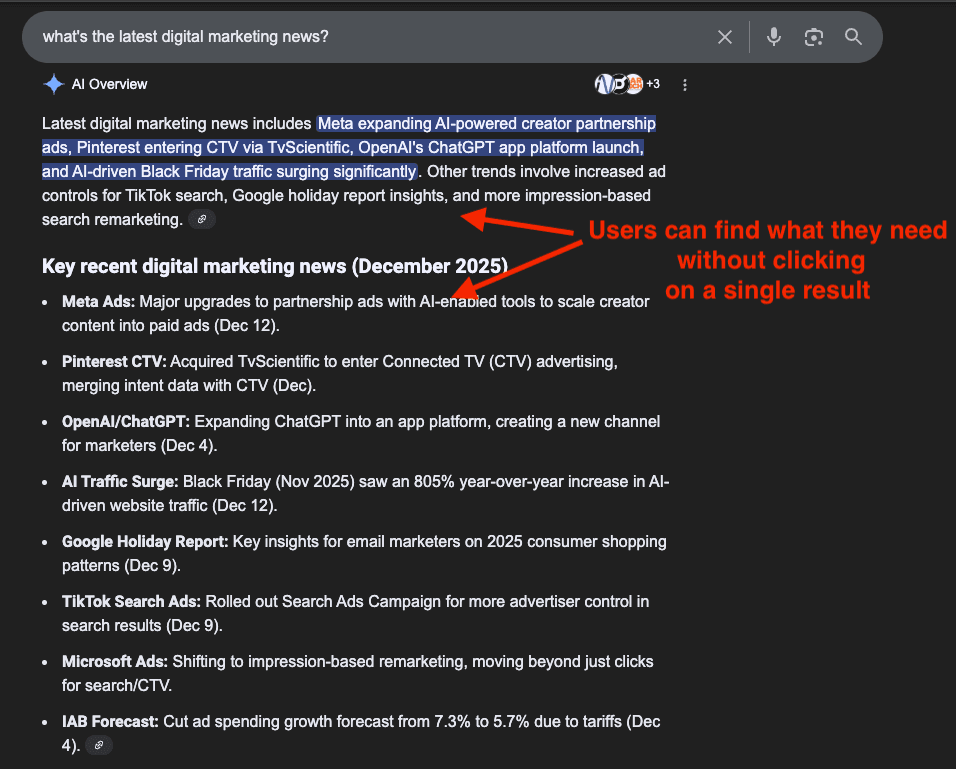
Because of this, zero-click searches have skyrocketed (where users leave the results page without clicking on any results).
Also, the presence of an AIO has the potential to negatively impact your click-through rate by over 30%, even if you’re ranked #1.
This puts marketers and small businesses who rely on SEO for visibility and leads in a tough spot.
The good news?
Adapting to AI-powered search is by no means impossible, and it turns out you don’t have to outright abandon your existing SEO playbook; you just need to make some useful additions to it.
We’ve unpacked Google’s AI search pipeline, so we know how its AI system ranks content.
SEO isn’t disappearing, it’s just evolving into something new.
Keep reading to learn how you can integrate AI search best practices into your SEO strategies.
What Google’s AI Systems are Doing Differently
After peeking under the hood of Google’s AI search system, we uncovered the processes it uses to:
- Pull online content related to user queries.
- Evaluate the content to determine if it’s helpful, trustworthy, accurate, and recent.
Here’s a breakdown of our findings.
AI systems ingest content in ‘chunks’

One of the biggest differences between AI search systems and classic search engines is how they index content.
When traditional search engines crawl web pages, they parse (read) every word of the entire document, including all the links, metadata, and images.
AI search, on the other hand, splits content into chunks (typically consisting of 300 - 500 tokens) with embeddings for vector search.
In other words, AI search systems do not process every word on the page.
Why do they split the content up into smaller sections?
Splitting content into smaller chunks lets AI systems understand a page’s meaning quickly and efficiently.
Chunks are essentially small semantic blocks that AIs can use to quickly pinpoint relevant content and generate snippets from it.
Without chunking, AI search models would have to scan massive full-page embeddings for every single user query, which would be incredibly slow and imprecise. That’s not to mention the additional resources necessary to pull off full-page indexing.
So, to prioritize speed, precision, and resource efficiency, AI systems use the chunking method to index content.
Meaning and clarity matter more than word count

Google’s traditional search engine algorithm is biased against ‘thin’ content, which tends to be pages containing fewer than 700 words.
The idea is that for content to be truly helpful, it has to provide at least 700 - 1,000 words worth of valuable information.
AI search is different.
There’s no direct penalty for publishing content that contains less than 700 words.
However, AI search systems do have a concept of thin content, it’s just not tied to word count.
AIs care more about:
- Semantic density – Is the text rich with concepts, entities, relationships, and other forms of depth?
- Chunk quality – Are there clear snippets within each chunk that answer common user questions?
Even if a piece of content is low on word count, it can perform well on AI search if it’s dense with useful information and structured into digestible chunks.
That means, on a platform like ChatGPT or in Google’s AI Overviews, a dense, tightly structured 300-word piece has the potential to outperform a 2,000-word ‘ultimate guide’ that’s mostly fluff and surface-level knowledge.
AI engines rely on a clean structure and an accurate understanding
How you structure your articles matters more in AI search than it does for organic search.
In traditional SEO, backlinks and keywords are the dominant signals, and a clean page structure is more of a user experience factor.
This is because search engines index each page holistically (word-for-word), so they’re able to tolerate loose structures like heading-free text blocks if the page’s authority is strong.
Since AI systems use chunking and rely on headings for context clues, content structure is integral to the way they retrieve and rank content.
What We Know from Google’s Enterprise Tools

The reason why we understand how Google’s AI search system works is that we reverse-engineered its official documentation for SEO purposes.
That’s how we discovered that:
- Google’s AI evaluates content in 300 - 500 token chunks.
- AI uses a combination of semantic understanding and traditional keyword matching
- Clear formatting and structured data (semantic HTML and schema markup) make content much easier for AI systems to parse and understand.
We also pinpointed the seven AI ranking signals all popular AI search platforms use, not just Google.
These include:
- Base ranking from the core algorithm
- Topic clarity from semantic understanding
- Old-school keyword matching
- Engagement signals
- Freshness
- Trust and authority
- Business rules and safety overrides
As you can see, LLMs (large language models) use a hybrid of classic SEO signals and modernized AI trust signals to rank content.
How This Impacts Traditional SEO
Next, let’s look at how AI search is impacting traditional SEO campaigns.
The most important takeaway is that keyword-focused content may not be enough anymore.
If your content isn’t structured to accommodate AI search tools, you could wind up getting overlooked, even if you traditionally rank well and have an outstanding backlink profile.
Here are the most important takeaways.
Long, unstructured pages are difficult for AI to understand

Remember, AI systems ingest your content in small chunks, not all at once.
Therefore, you need to break your articles up into hyper-focused subheadings that do not venture off each subtopic.
If your blogs are lengthy and unstructured, you risk confusing AI systems. If you don’t follow a logical page hierarchy, an AI system may falsely determine that your post is about something else entirely.
Here are some pointers:
- Use H2s and H3s to divide the post up into clearly defined subtopics
- Once the subtopic is set, DO NOT bring up unrelated topics.
- The original headings will carry with each chunk, which is why subheadings are critical for understanding.
Outdated content loses visibility quickly

AI systems are able to interpret temporal intent, which is when a query requires the most recent information.
Because of this, AI search has a very real recency bias.
Even your evergreen pieces need the occasional update and timestamp refresher to be considered ‘fresh’ by AI standards.
Periodically updating old posts was always an SEO best practice, but it’s even more important in AI search.
Keywords are only a small piece of the ranking puzzle
In AI search, keywords are only a supporting signal that keeps the results grounded in content that’s actually relevant.
Why is this necessary?
While meaning-based search (vector search) is very sophisticated, it can veer off topic quite easily.
Search keywords help AI systems ensure the results they retrieve directly relate to the user’s prompt.
This means that it’s still important to use exact-match keywords in your content. At the same time, they aren’t nearly as impactful as they used to be. Keywords are only one ‘vote’ in a stack of seven equally important trust signals.
Beyond using keywords, your content should:
- Use structured data, clear headings, and contain ‘chunkable snippets’
- Flesh out your area of expertise in as much topical depth as possible
- Contain clear definitions, concepts, and entity relationships
Also, off-page signals like authoritative brand mentions and backlinks are massively important, too.
Areas Where Classic SEO is Still Very Important

As we said, the AI search pipeline is a hybrid mix of classic SEO and AI-powered trust signals.
Accordingly, there are many traditional SEO tactics that not only still work, but are essential for success.
Here are the standard SEO techniques that you should NOT abandon:
- Local SEO best practices, like managing reviews, NAP (name, address, and phone number) consistency, and GBP management, all strengthen the entity signals that AI systems use.
- Technical SEO improves structure and clarity. At the same time, UX factors like page speed and site hierarchy are extremely important for AI visibility.
- Keyword research will let you know the exact phrases your target audience looks up online.
- Backlinks remain powerful trust signals across all search systems.
How The HOTH Supports This New Reality
The transition to AI-powered answers isn’t something that took us by surprise. We saw it coming a mile away, and we’ve been preparing for the last few years.
As a result, our product line is already tailored to the preferences of LLMs AND classic search algorithms.
We offer:
- Managed SEO campaigns for long-term improvements to online visibility on traditional search engines and AI search systems.
- AI Discover for improving AI visibility specifically.
- Diverse link-building campaigns to strengthen authority and trust.
- Smart content services focused on clarity, topical structure, and depth.
- Technical SEO to lay the foundation for strong online visibility and a fantastic user experience.
- Local SEO support to improve entity understanding (ensuring brand consistency).
Whether you’re interested in SEO or GSO (generative search optimization), our team has the expertise and toolset to take you in whichever direction you desire.
Final Thoughts: Understanding AI Search SEO
There’s no denying that SEO has evolved into something new. AI-powered search features aren’t going anywhere anytime soon, so the best thing business owners can do is adapt their existing strategies.
As we’ve pointed out in this article, there are many SEO techniques that remain viable (and even crucial) in the AI search era.
The key to success is leaving what works, getting rid of what doesn’t, and adding some new best practices into the mix, like creating ‘chunkable’ content.
Do you need expert help adapting your SEO strategy to include AI?
Book a free strategy session with our team to find the clarity you need to continue finding success.
The author
Rachel Hernandez
description

Previous
Google Uses Seven Signals to Rank AI Answers: How Small Businesses Can Improve Them
Next
How Much Do SEO and GSO (Generative Search Optimization) Cost in 2026?
Discussion
Comments
Chris Juliano
December 21st, 2025
Wow great article guys. I saved it to my favorites. I am putting money aside to design a new website in WordPress and then I will hand it over to you to handle the SEO. I’m also in the process of moving to St. Pete! Can’t wait to work with you guys!
Louise Savoie
December 19th, 2025
Clear and timely insights. AI search is changing how content gets discovered, especially with chunking and AI overviews reducing clicks. I think this is a good reminder that structure, clarity, and topical depth matter more than long content. Great read and thanks for sharing!

